


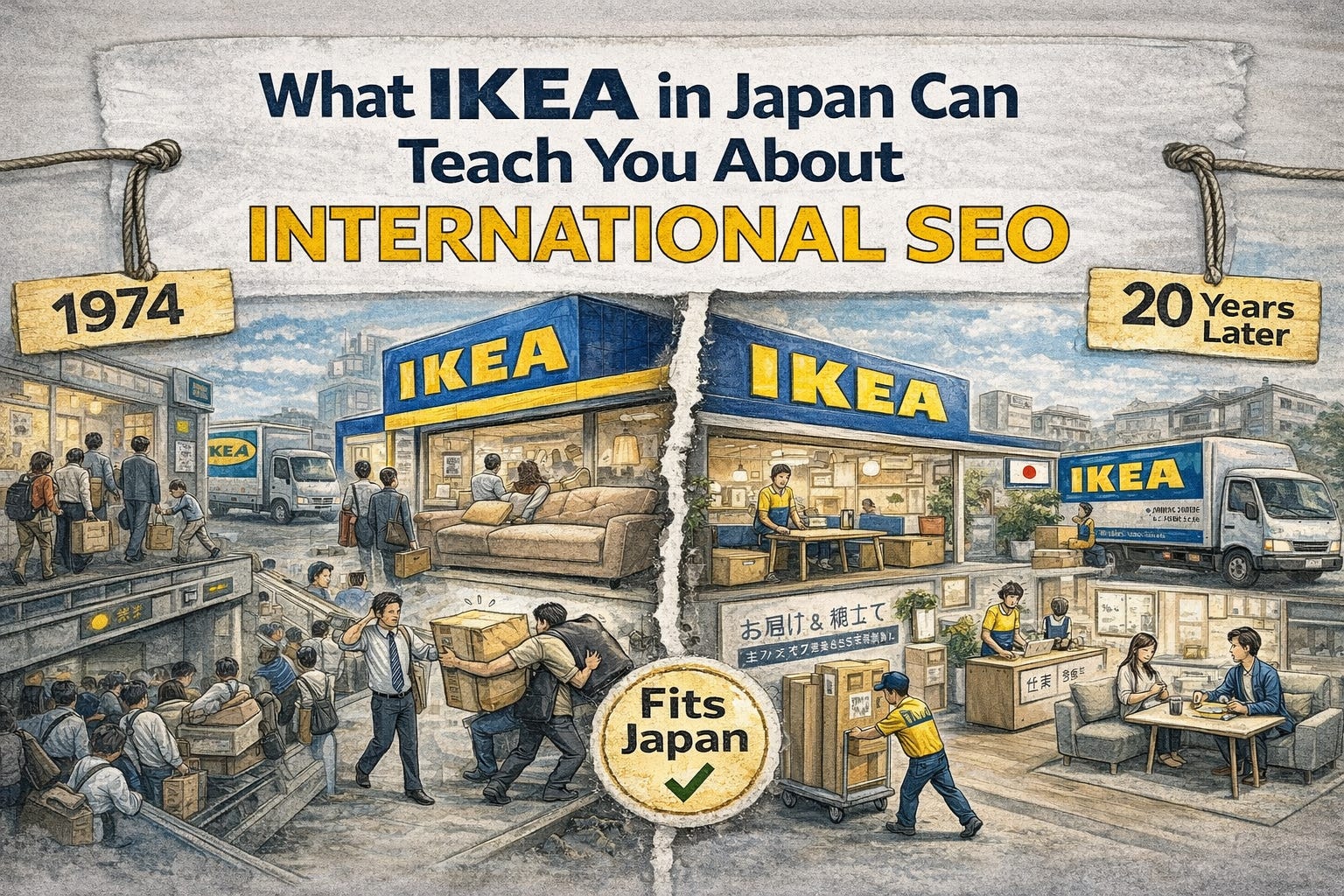
IKEA launched in Japan in 1974. Their furniture was beautiful, affordable, exactly what had worked across Europe.
Twelve years later, they pulled out completely.
The problem wasn’t quality. Wasn’t price. It was size. IKEA’s standardized dimensions (perfect for Northern European apartments) were comically oversized for Japanese homes.
Three-seat sofas that couldn’t fit through doorways. And most Japanese consumers didn’t own cars, so they were expected to haul these massive flat-packs home on packed subway trains.
IKEA resisted adapting. They figured customers would adjust.
They didn’t.
Twenty years later, IKEA returns to Japan with a completely different approach. They curated only products that fit Japanese apartments. Shortened sofas. Added delivery and assembly services. Designed showrooms around typical Japanese living spaces.
Today? Multiple stores across Japan. A localization success story.
So why am I telling you this furniture story in an SEO newsletter?
Because the exact same dynamics are playing out right now with AI-powered international SEO. The technology makes it trivially easy to launch in new markets. Does absolutely nothing to help you win in those markets.
You can spin up translated pages in 47 languages by Friday. Doesn’t mean anyone will trust them, rank them, or convert on them.
Let me show you where this is all heading.
Before we get into the weeds, let’s nail down what “international SEO” actually means (because half the confusion comes from people using the same term to mean completely different things).
International SEO is really two jobs running in parallel:
First job: Make search engines understand which version of a page is for which audience. Language + country/region. This is the technical layer (site structure, indexing signals, canonicalization, hreflang tags).
All the machinery that keeps search engines from showing your French-Canadian page to users in France (or vice versa).
Second job: Make humans in each market feel like the page was built specifically for them. Not just language. Cultural norms, trust signals, UX expectations, the unspoken rules that separate “this brand gets me” from “this is clearly a foreign company trying too hard.”
AI touches both jobs. What’s fascinating (and where teams are getting destroyed) is watching how those two responsibilities blend together in ways that create entirely new failure modes you wouldn’t see coming.
Two things changed the game in last one decade:
Neural machine translation made “good enough at scale” realistic starting around 2016. But the real breakthrough came in 2017 with the transformer architecture, which fundamentally changed how translation models work.
Since then, progress accelerated fast. Google’s PaLM 2 in 2023 demonstrated that large language models could outperform traditional translation systems. In 2024, this enabled Google Translate’s biggest expansion ever (110 new languages), reaching 614 million more speakers.
But translation quality still varies wildly. Portuguese to English? Excellent. Idiomatic Japanese to German? Still challenging. Recent research shows that claims of “human parity” need serious caveats.
What this means: AI makes it cheap to spin up thousands of localized pages fast. Doesn’t make them correct, culturally appropriate, or aligned with actual search intent.
The second shift?
Google now bridges language gaps automatically. They’ll translate snippets on the fly. Sounds helpful until a user in Madrid lands on your auto-translated English page, bounces because the tone feels off, and your rankings slide.
There’s a foundation layer AI can help with (or completely obliterate). Think of it as the physics layer.
First: correct locale signaling. Google’s documentation is explicit about hreflang annotations. AI can generate these at scale. Beautiful in theory.
In practice? Auto-generate the wrong mapping and you create indexation chaos. I’ve seen teams launch thousands of AI-generated pages where 30% had broken hreflang. Google ignored the whole setup. Months of work, zero ranking benefit.
Second: language tagging standards. Web standards push hard on BCP 47 language tags. AI workflows constantly produce mismatched labels. I’ve watched an AI tool assign “zh-CN” to traditional Chinese content meant for Hong Kong (should be “zh-HK”). Small mistake, weeks to fix.
So where does AI actually help in International SEO?
Market selection: AI can synthesize demand proxies, competitor footprints, content gaps, and cost models. When done right, it beats “we should probably do Germany because... Germany?”
ActiveCampaign did this when expanding into French, Italian, German, and Spanish markets. They identified which keywords had real search volume per market, which topics needed education versus direct pitches.
Over eight months: 392 pages across four languages, 83,000 additional clicks, 4.1 million more impressions.
That’s market-informed expansion, not translation.
Keyword and intent modeling: Here’s where most teams die. Literal translation fails because search intent isn’t the same across cultures.
ActiveCampaign discovered Italian users needed more educational content before purchase. German users obsessed over data privacy. Spanish markets responded to completely different pain points.
They couldn’t translate their English keyword strategy. They rebuilt it per market with native specialists. Result: 73% year-over-year traffic increase to their Spanish blog, 111% rise in Spanish Help Center usage.
That’s the difference between “we translated it” and “we understood the market.”
Content localization operates on a ladder:
Translation = meaning transfer
Localization = meaning + locale conventions (currency, date formats, payment methods)
Transcreation = meaning + persuasion adapted (tone, humor, cultural references)
A CTA like “Grab yours now!” works in the US but sounds unprofessional in Germany. In Japan, it can feel disrespectful.
AI speeds drafts dramatically. But “quality” is multi-dimensional. Linguistic fluency doesn’t equal cultural resonance doesn’t equal SEO outcomes. You can have perfectly fluent content that ranks terribly or converts poorly.
Cultural adaptation is where teams under-invest and AI both helps and harms.
Nielsen Norman Group breaks this down: high-context cultures (Japan, Middle East) prefer indirect cues. Low-context cultures (US, Germany) want explicit information.
When IKEA returned to Japan, they didn’t just resize furniture. They redesigned the entire experience. Swedish cafés became destinations. Menu items adapted (matcha lattes alongside meatballs). Plant-based options aligned with local sustainability values.
They understood complete cultural context, not just product dimensions.
AI can generate culturally appropriate variants and flag risky phrases. But it can also produce generic content that feels flat or miss delicate social norms.
One indie game developer launched on Steam Japan with machine translation. The title became “クソダンジョン” (”Sh*tty Dungeon”). Brand-destroying failure overnight.
And localization isn’t just text. It’s product UX. Engagement signals depend on localized checkout flows, local payment methods, shipping estimates that match expectations.
What happens when you deploy AI-driven international SEO at scale?
Speed-to-market becomes realistic. But volume is easy. Differentiation isn’t.
I’ve seen an eComm brand launch with 7,000+ AI-translated product pages and get zero traction because none felt native. It’s like showing up to a business meeting in another country wearing technically appropriate clothing that’s just... slightly off.
Everyone notices. Nobody says anything. You don’t get the deal.
In markets like China (Baidu), South Korea (Naver), and Japan (Yahoo Japan), local search engines have different ranking factors. You need local hosting, local backlinks, structured data that reflects regional expressions of authority.
AI can identify gaps but can’t be a substitute for building relationships.
Policy and governance keep this from turning into a penalty factory.
Google maintains spam policies and Bing explicitly discusses “automatically generated content.” Both watch for massive content production without quality checks.
The tension: AI is phenomenal for scale. Search engines are wary of scale without value. If your process is “AI translates everything, we publish immediately,” you’re building a penalty waiting to happen.
Professional hreflang audits routinely find improper implementation causes ranking drops. Most aren’t caught until traffic crashes.
DeepL’s 2024 survey found 96% reported positive ROI from localization, 65% reported 3× ROI. But that’s proper localization with human oversight, not machine translation dumped onto pages.
Most teams approach this as cost-cutting. “We can translate faster and cheaper!” Then wonder why conversions never materialize.
The actual play: use AI for mechanical work (hreflang generation, translation drafts, technical QA) so humans can focus on cultural adaptation, intent alignment, trust building.
Think about it: AI is incredible at the “what” and “how much.” Terrible at the “why” and “so what.” You need both.
If your international SEO strategy starts and ends with “we used AI to translate everything,” you didn’t build an international presence. You built 10 versions of the same site that all fail to convert in different languages.
IKEA learned this twice. First failure taught them standardization doesn’t work everywhere. Second attempt taught them to balance global brand consistency with local market adaptation.
Twenty years between attempts. You can learn it faster. Question is whether you’ll learn it the easy way by paying attention to what actually drives results in each market, or the expensive way by launching fast, failing hard, and fixing it later when you’ve already burned trust.
Human oversight isn’t optional, or not just nice-to-have. It’s the entire point.
Because you’re not trying to fool algorithms into ranking pages. You’re trying to build trust with humans in markets you don’t fully understand yet. AI can help you move faster. Can’t help you move smarter unless you’re steering it with actual market knowledge and cultural understanding.
That part still requires humans. Probably always will.
See ya next week..
Signing off
Pankaj & Vaishali