


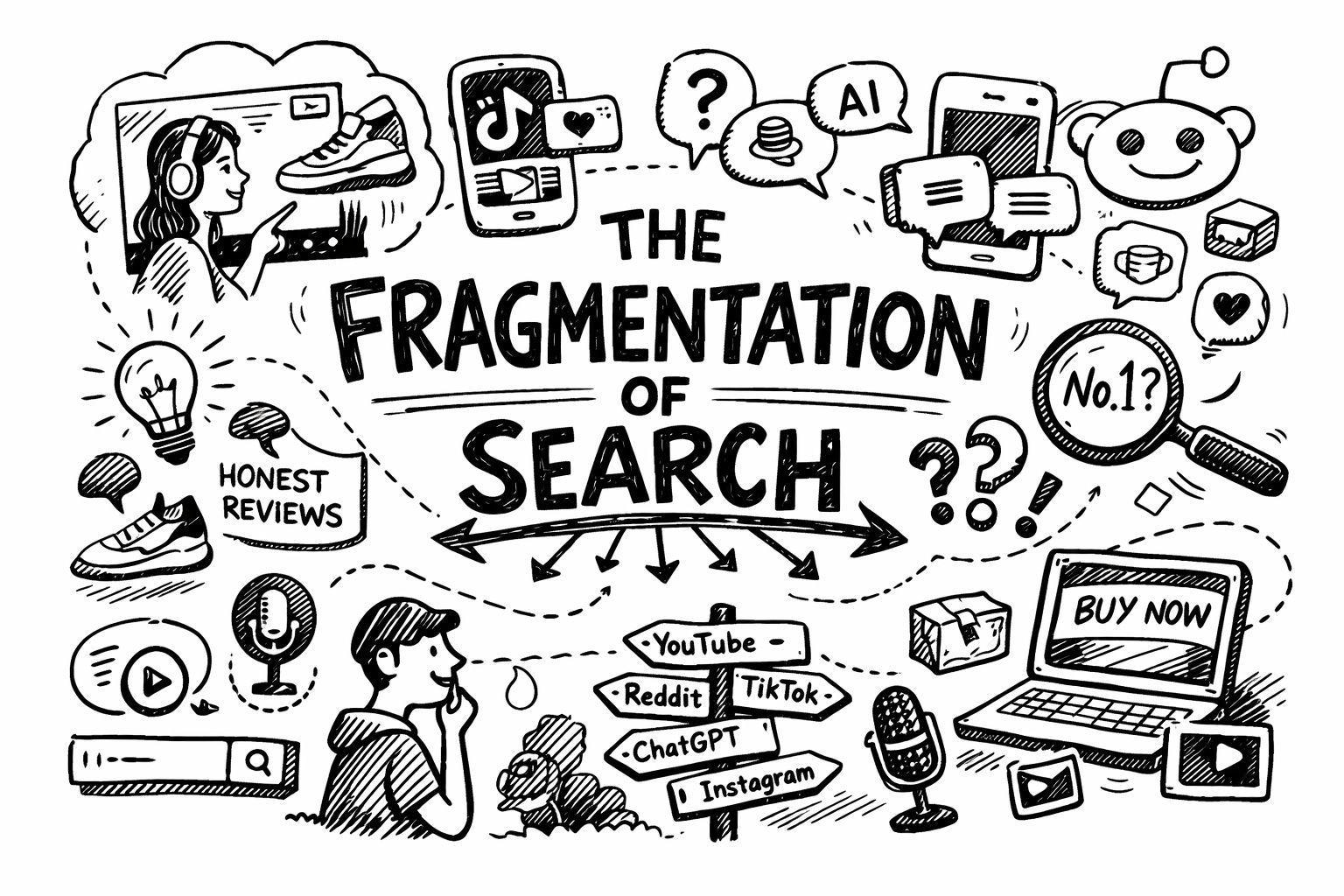
For 20+ years, search was a muscle memory.
Something pops into your head, your fingers hit Google, ten blue links show up. Click one. Done.
Not sexy. Not exciting. Just... there. Like gravity.
That predictability built entire careers. We spent two decades perfecting one loop: rank, click, convert, repeat next month.
Then people stopped restricting themselves to Google only.
I watched my 21-year-old cousin buy sneakers last week. She started on Google, sure, but only to narrow down to 2 or 3 pairs. Then she jumped to YouTube to watch her favorite creator review them.
From there, Pinterest to see how they actually looked on real people in real outfits. ChatGPT to ask which model had better arch support. Reddit to find “honest opinions” and “I’ve worn these for 6 months” threads.
Only after bouncing through five different places did she land on a brand website. And by then? The decision was already made.
What she was doing was search. Just not the search we spent two decades optimizing for.
The funnel didn’t collapse. It scattered.
This Is What Search Looks Like Now
Here’s what happened while we were all busy cranking out content briefs and chasing keyword difficulty scores.
People figured out that different platforms are better at different jobs.
“Explain this concept to me” → ChatGPT, Claude, Perplexity
“Is this thing actually legit?” → Reddit, review sites, communities
“Show me how to do this” → YouTube
“Where do I buy it?” → Amazon, marketplace apps
“Just handle it for me” → Agents (coming faster than you think)
Daniel Kahneman spent years documenting this in cognitive psychology research. People instinctively pick whatever path requires the least mental effort.
And the internet just reorganized itself around that principle, and nobody needed to announce it.
You know, nearly 45% of Gen Z now start searches on TikTok or Instagram instead of Google. Another 40% actively choose them over Google depending on what they’re looking for.
Not because Google got worse (they still own the 89% share in search). Because trust became easier to find somewhere else.
Why Every Platform Wants to Be a Search Engine Now
Picture this from a platform’s perspective.
For decades, Instagram and YouTube and Reddit were doing all the work of creating intent. Someone would see a product, get interested, then leave to Google it. They’d click around, maybe buy, and never come back to thank the platform that sent them.
Platforms generated the demand. Google captured the transaction.
That was fine when search felt like one place. It stopped making sense the moment ChatGPT hit 100 million users in two months and showed people that answers don’t need ten blue links.
Google even issued a Code Red in December 2022. That’s not speculation, that actually happened.
But AI wasn’t the only wake-up call. The creator economy exploded during COVID. Lockdowns pushed everyone online. Time spent on platforms doubled. Content views per post more than doubled. Creators got reach they’d never seen before and just kept producing.
The creator economy sits somewhere between $150 billion and $210 billion right now. Projections have it hitting $525 billion to over $1 trillion by 2030.
So users started asking questions directly inside the platforms while watching creators. And the platforms noticed search was leaking value right through their fingers.
After that, here’s what went down:
Reddit built native search and AI-assisted answers that pull from years of discussion threads and hand you a single response.
YouTube doubled down on making video the primary way people learn, evaluate, and make decisions. Not just entertainment. Discovery.
TikTok turned into a recommendation engine where every swipe is a query and every video is an answer. Half the time it leads straight to checkout without ever leaving the app.
Meta’s building its own AI search engine to cut dependence on Google and Microsoft. Although, they already replaced the search bar across their apps with conversational search baked into the social feed.
Every platform reached the same conclusion on their own: If users are already searching here, why the hell are we sending them somewhere else to finish the job?
Google stopped being the default for search.
What This Actually Means For SEO (The Part You Care About)
OK, so what the hell does this mean for your actual job?
The hard part isn’t learning new tactics. It’s wrapping your head around the fact that visibility works completely differently now.
A few years back, SEO was beautifully simple. Rank on Google, get traffic, convert. Done. That worked because everything happened in one place.
Not anymore.
Here’s what actually happens now:
Someone’s scrolling YouTube and sees your brand mentioned in a review. Two days later, they’re on Reddit and spot a thread echoing the same take you’ve been pushing. Then they ask ChatGPT a question and your exact framing shows up in the answer.
By the time they land on your site, they’re not comparing meta descriptions. They’re thinking, “OK, these people actually know what they’re talking about.”
That’s the whole game now.
People don’t remember *where* they first saw you. They remember *how often* they saw you saying the same damn thing across different places they already trust.
And here’s the weird part: that repetition doesn’t feel like marketing to them. It feels like expertise. Like you’re just... everywhere. In a good way.
It means, authority stopped living in your website domain.
It’s in the mentions, the citations, the times a creator name-drops you, the language people borrow when they explain your category. It builds every time your voice stays consistent no matter where someone bumps into it.
One viral post won’t do it. One big rankings win won’t either.
What actually works is showing up with the same point of view, over and over, in the places people already hang out. Until it stops being new information and becomes “yeah, obviously.”
And this is where our dashboards start lying to our faces.
When search scatters across five platforms, clicks become optional. Sometimes the answer resolves before anyone visits your site. Sometimes someone decides to trust you long before they ever open your homepage.
That’s what “zero-click” really means. Not that Google stole your traffic (though sure, that too). It means we’re still measuring 2018 user behavior while everyone moved on to 2025.
Traffic didn’t disappear. It just stopped walking through the front door we’ve been watching for 20+ years.
So yeah, SEO evolves. Gets bigger, not smaller. Less about owning the top spot. More about being the name people recognize and trust when they’re finally ready to make a decision.
Wherever the hell that decision happens.
The Uncomfortable Reality of Search Fragmentation
Look, fragmentation isn’t the crisis everyone’s making it out to be.
It’s actually a filter. And honestly? A pretty good one.
It filters for clarity. For people who actually know their stuff, not just people who figured out how to game one algorithm. For ideas strong enough to survive getting repeated fifty times without sounding stupid.
The brands winning right now are the ones that feel familiar by the time someone’s ready to buy.
Search stopped being a place you visit. It’s a state people arrive at after bouncing through five different apps and platforms.
So the only question that matters anymore:
Do we show up in those moments when someone’s mind clicks from “maybe” to “yeah, let’s do this”?
That’s it. That’s the strategy.
Signing off
Pankaj & Vaishali