


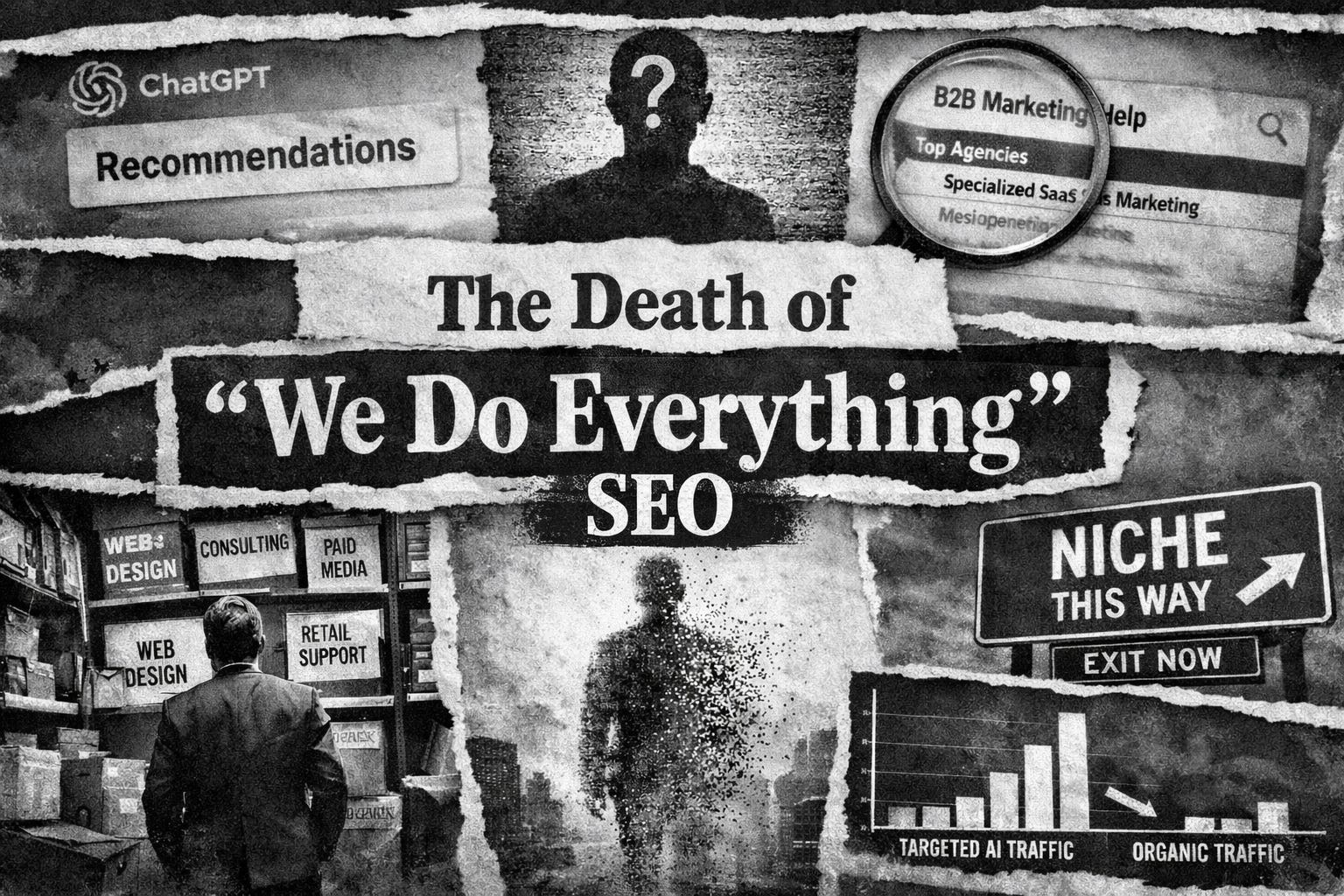
Two months ago, a friend texted me a screenshot. Her marketing agency didn’t show up at all in ChatGPT’s recommendations for “B2B marketing help.” Her competitor (half the size and charging 30% less) was in the top three suggestions.
The only meaningful difference: the competitor’s entire web presence screamed “SaaS lifecycle marketing for Series A startups.” My friend’s agency? “Strategic marketing solutions for growing businesses.”
That vagueness cost her a $40k retainer. The prospect never knew she existed.
Positioning isn’t marketing polish anymore. It’s infrastructure. The algorithm deciding whether you exist doesn’t care about your versatility or your impressive client roster. It wants one answer: What bucket do you go in?
Get it wrong and you disappear.
And disappearing has a price tag now.
ChatGPT mentions brands 3.2 times more often than it cites them with links. When someone asks for recommendations in your category, the AI either knows what you are and mentions you, or it doesn’t and you’re invisible. Just gone.
The brands getting mentioned? Their AI search traffic converts at 4.4 times the rate of traditional organic traffic. Higher intent, clearer fit, better outcomes. The brands not getting mentioned are losing deals before the conversation starts, watching competitors win customers who never knew alternatives existed.
Here’s the part that should terrify generalists: fewer than 25% of the most-mentioned brands are also the most-sourced. Being everywhere doesn’t guarantee visibility. Being clearly classified as the answer to a specific question does.
So what does positioning actually look like when it works?
The Brands That Got This Right
Google became the verb for search. Not “the leading search engine” or “the most popular way to find information online.” Just search itself. When something’s confusing, people say “Google it.” Not “search for it on a search engine.”
That’s what sharp positioning does. It collapses the gap between category and brand until they’re the same thing.
Kleenex owns facial tissue. Band-Aid owns adhesive bandages. Xerox owned photocopying so hard that people said “xerox this” while standing at a Canon machine. The category disappeared into the brand name.
Software follows the same pattern. Salesforce doesn’t sell business software. They sell CRM. Slack doesn’t sell enterprise communication platforms. They sell team chat. Zoom doesn’t sell video conferencing solutions. They sell video calls. Each one claimed specific territory and defended it until asking for the category meant asking for the brand.
The companies that hedged? Dead or dying.
Yahoo tried being search, email, news, portal, everything. Google killed them by just being search. Evernote tried being notes, tasks, collaboration, web clipping, documents. Notion beat them by being a workspace. Skype tried being calls, video, chat, collaboration. Zoom focused on video and won.
Specific beats general. Every time.
Now here’s where this gets worse for most businesses.
The Classification Game You’re Already Losing
Picture this: an AI organizing a storage unit. It wants neat rows, clear labels. Hand it a box labeled “Sometimes tools, sometimes sporting goods, sometimes kitchen supplies depending on the season,” and it freezes. Can’t classify it, so it shoves it in the back corner.
That’s what happens when you tell the algorithm you do everything.
Web design, paid media, enterprise consulting, local retail support all on the same homepage. You’re not demonstrating range. You’re creating classification paralysis.
HubSpot owned “inbound marketing software” for years. Marketo owned “marketing automation.” Both specific, both clear. Then came the “marketing platforms” trying to be everything at once. Most died. The survivors narrowed down. Mailchimp focused on email marketing for small business. ActiveCampaign doubled down on marketing automation for SMBs. ConvertKit sharpened to email for creators.
Same pattern everywhere. Zoom did video calls, killed Skype doing calls plus video plus chat plus collaboration. Dropbox did file sync, beat Box doing storage plus collaboration plus workflow plus content management. Intercom did customer messaging, beat Zendesk trying to be support and sales and messaging and knowledge base.
This gets worse in a fragmented search world.
Your customers don’t just search Google anymore. They ask ChatGPT, check Reddit, scroll TikTok, try Perplexity. Each platform classifies you independently. Each one decides if you fit the query.
Vague positioning that barely worked on one platform fails catastrophically across five. Google might have given you credit for versatility through backlinks and domain authority. ChatGPT doesn’t care about your domain authority. Reddit doesn’t care about your backlinks. They care what you are, and if they can’t tell, they recommend someone who made it obvious.
Generalists used to win by being the one-stop shop. In 2026, generalists lose by being unclassifiable.
Let me show you exactly what this looks like in practice.
Why “We Do Everything” Translates to “We Are Nothing”
Listing every capability feels smart. You built those skills. Cutting them feels like leaving money on the table.
Here’s what actually happens.
Someone searches for help with a specific problem. Infrastructure management for a software shop. Lifecycle email for a DTC brand. They describe it to an AI, and the AI filters through businesses that match.
“We help organizations scale” triggers a red flag. Scale how? Scale what? Which industry? The AI has 47 other options that gave clear answers. You don’t make the list.
Test this yourself right now.
Open ChatGPT and ask: “What are the best CRM tools for small businesses?” Watch Salesforce, HubSpot, and Pipedrive appear immediately. Now ask: “What are the best business software tools?” Watch it struggle, ask clarifying questions, hedge with generic categories.
Try it with your own category. Ask for the specific thing you do. Do you show up? Now ask for a vague version of what you do. Does anyone show up clearly, or does the AI flounder trying to narrow the question?
That floundering is what happens to your business when you position vaguely. The AI can’t slot you anywhere specific, so it doesn’t recommend you at all.
Specificity isn’t limiting. It’s the filter that gets you into the conversation. “We manage IT infrastructure for software development firms” tells the algorithm exactly what box you belong in. When someone asks for that thing, you show up.
This creates a compound effect. The more consistently you signal one specific thing, the stronger your classification becomes. The AI stops hedging. You become the primary recommendation.
Here’s the part that breaks most people’s brains: narrower positioning generates MORE total traffic, not less.
A software development agency had 23 blog posts targeting keyword variations around “API documentation.” Each post competed with the others. None ranked above position 8. They consolidated into one canonical page about API documentation with supporting content exploring adjacent entities like API design and developer onboarding.
That single page started ranking positions 1-3 for over 40 related queries within 60 days.
The narrow focus didn’t limit them. It concentrated all their authority signals into one clear entity that Google could confidently recommend for everything related to that topic.
Vagueness destroys that confidence. Every time you add “and we also do this completely different thing,” you dilute the signal. Should it classify you as an infrastructure shop or a consulting firm? It can’t answer, so it doesn’t recommend you.
The businesses winning aren’t the most versatile. They’re the most boringly clear about one specific thing they do for one specific type of client.
OK, the part you actually need to understand.
The Entity Optimization Framework
Entity-based SEO undersells what’s happening. You’re teaching AI systems who you are using the same signals humans use: consistency, specificity, repetition.
An entity is a distinct, well-defined thing. A restaurant has cuisine type, price range, location, hours. A software company has product category, target market, technology stack, pricing model. The clearer those attributes, the easier the entity is to classify and recommend.
Building a strong entity means controlling those attributes everywhere they appear. Website, LinkedIn, Google Business Profile, team profiles, case studies, guest posts, podcast appearances.
Here’s where most brands fall apart.
Website says “enterprise software consulting.” LinkedIn says “digital transformation partners.” Founder’s bio says “technology strategist and advisor.” The AI encounters this inconsistency and has to choose which signal to trust, or it averages them into mush.
Start with your core category. Not “marketing” or “consulting” but the specific subcategory you operate in. “Lifecycle email for DTC brands selling physical products.” “Growth marketing for mobile gaming companies.” “IT infrastructure for venture-backed SaaS startups.”
If you can’t define it that specifically, you don’t have a category. You have a vague description.
Define your target explicitly. Not “businesses” but the actual profile. Industry, size, stage, business model. Payroll software for restaurants with 10-50 employees is a different entity than payroll for tech startups with remote teams. Same product category, different entities.
Watch how the winners do this.
Gusto says “payroll, benefits, and HR for small businesses.” Rippling says “workforce systems for fast-growing companies.” Same basic product, completely different positioning. Both winning their lane.
Carta doesn’t do financial software. They do equity management for private companies. Brex doesn’t do corporate cards. They do financial services for startups. Stripe doesn’t do payment processing. They do payments infrastructure for internet businesses.
Each one picked specific category plus specific target. Then they hammered that positioning everywhere. Homepage, case studies, API docs, founder interviews, support pages.
The repetition isn’t lazy copywriting. It’s how entity classification actually works.
Now reinforce that category and target everywhere someone might encounter you. Homepage headline, meta descriptions, team bios, case studies, social profiles, email signatures. Not word-for-word copy, that’s lazy. The same core positioning expressed consistently.
The AI builds confidence. Same category on your website, confirmed in LinkedIn, reinforced by your case studies, echoed in what you write about. Every signal strengthens the classification. After enough exposure, the system stops questioning what you are.
That knowledge gets you recommended. When someone asks for what you do, the AI doesn’t hesitate. You move from maybe to obviously.
Now comes the hard part.
The Painful Part: Choosing What to Cut
The hardest conversation isn’t about what to emphasize. It’s about what to delete.
Nobody wants to hear their versatility is killing them. Everyone has that story about the weird client project that worked out great, proof they can adapt.
Those stories are true, and they don’t matter.
The algorithm doesn’t care what you could theoretically handle. It cares what you fundamentally are. If 80% of your messaging points to one thing but 20% points to five other things, you’ve added enough noise to confuse the classification.
“But we really do serve enterprise and small business.”
Pick one to position around. You can still take the other work when it shows up, but stop advertising both. Position for enterprise, get enterprise leads. Take small business through referrals if you want, but don’t split your entity profile courting both.
Same for service breadth. Strategy, execution, training, all genuinely good. Choose the one that defines you, that represents the majority of revenue or where you want to grow. Push the others into supporting roles, not the headline.
The fear is “If I narrow, I’ll lose opportunities.”
The reality is opposite. Narrowing makes you visible for opportunities that match. Right now you’re invisible for everything because you’re too broad to classify.
Watch what happens when you tighten positioning.
The leads that come in actually fit. They found you looking for exactly what you do. Qualification becomes easier. Sales cycles shorten. Project fit improves.
The wrong opportunities stop coming, the ones that would have been bad fits anyway. That’s not a loss. That’s filtering working in your favor.
The Boring Clarity That Actually Wins
None of this is sexy. Narrowing your positioning, reinforcing it everywhere, saying the same specific thing until the algorithm classifies you. It feels limiting compared to “we can do anything.”
But expansive doesn’t win anymore. Specific wins. Boring wins.
The brand that plants a flag in one clear territory beats the brand trying to claim the whole map.
The timeline isn’t instant, but it’s faster than most SEO.
Entity consolidation shows initial improvements in 30-60 days as authority signals concentrate. Broader classification that impacts AI mentions and knowledge graph positioning takes 90-180 days as systems verify your entity relationships through sustained consistency.
Brands with highly fragmented positioning see the fastest gains. Going from 23 scattered pages to one canonical entity page produces measurable results within two months. Brands starting from scratch need longer, but the compounding effect kicks in hard once classification solidifies.
Your competitors who figured this out six months ago are already showing up in AI recommendations while you’re completely absent, wondering why ChatGPT doesn’t understand how versatile you are.
The algorithm understands perfectly. You’re too versatile to classify, which means too versatile to recommend.
Pick your lane. Make it narrow enough that the AI knows exactly what box you belong in. Stay in that lane until the system stops questioning whether you belong there.
The brands that refuse this, that cling to positioning as generalists, are about to learn an expensive lesson. In a world where AI controls discovery, being everything to everyone means being invisible to the algorithm.
And invisible means irrelevant.
Pick your lane. Make it boring and specific. Do it this week.
Meanwhile, see you on next thursday.
Signing off
Pankaj & Vaishali
Didn't expect this take on positioning, but you're absolutly right. It's like algorithms are forcing a hyper-specific data structure on everyone now. Wild.