

I spent the past month buried in research on agentic AI in ecommerce. Not the chatbot stuff everyone’s been hyping for two years but the actual autonomous agents that plan, compare, and buy on behalf of users across multiple sites without human hand-holding at each step.
The shift isn’t theoretical anymore. OpenAI and Stripe launched a protocol that lets AI agents complete purchases inside ChatGPT. Google, Mastercard, PayPal, and Adobe backed a competing standard. Salesforce shipped their Agentforce platform and McKinsey projects agents could orchestrate $3 to $5 trillion in global retail by 2030.
That’s not a consultant speak. That’s infrastructure getting built right now while most ecommerce teams are still arguing about whether to add a chatbot to their footer. Let’s understand this:
Agentic AI Isn’t a Chatbot
Agentic AI in ecommerce means autonomous agents that handle multi-step workflows: discover products across sites, compare options based on preferences, check inventory and delivery, then execute a purchase or hand you a shortlist.
The chatbots you’ve been testing answer questions. These take action.
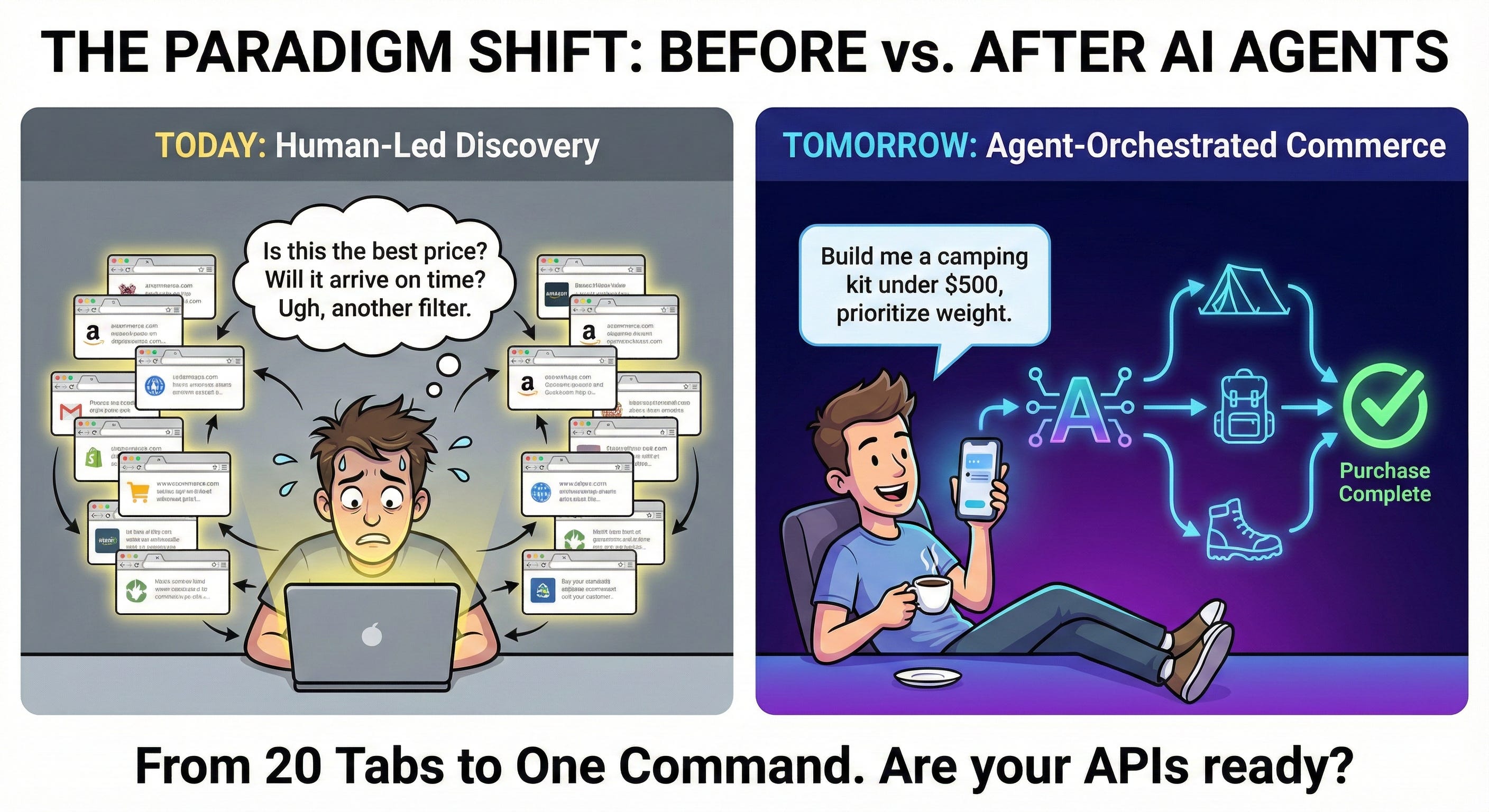
Picture this: you need camping gear under $500. Today, you open six tabs, filter by price on each site, compare specs, check reviews, verify shipping times, then finally check out on one. Tomorrow, you tell your agent “build me a camping kit under $500, prioritize weight and weather rating,” and it handles the rest.
Gartner and Salesforce estimate roughly one-third of enterprises will deploy agentic AI by 2028, up from nearly zero today. Your competitors are building this into their roadmaps right now.
How Shopping Actually Changes
Shopping moves from “users navigate to your site” to “agents orchestrate outcomes across multiple providers.”
Your website traffic won’t just decline but a significant chunk will disappear entirely. Customers increasingly interact through conversational interfaces, and many transactions happen without anyone visiting your website. What the industry calls “zero-click” or “invisible” commerce.
Here’s what that looks like in practice.
Commerce shifts from vertical destinations to horizontal, intent-driven ecosystems. Instead of going to Amazon for household stuff and your brand site for specialty items, a single agent handles groceries, fashion, bills, and travel across dozens of providers based on one shopping list or set of preferences.
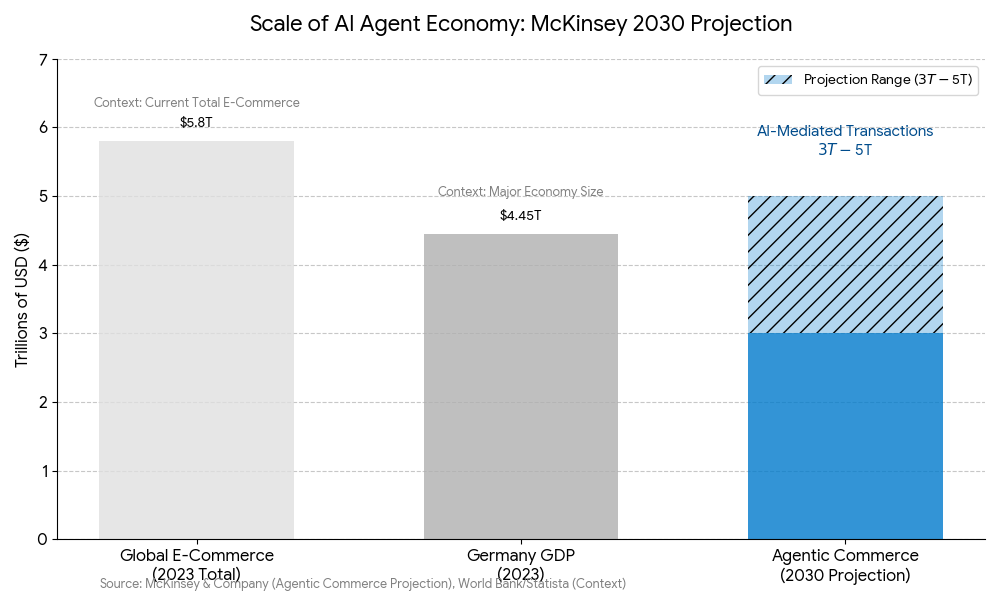
McKinsey’s $3 to $5 trillion projection by 2030 means a huge fraction of online transactions get mediated by AI agents rather than direct human browsing. If you’re running an ecommerce business and that number doesn’t make you rethink your acquisition strategy, you’re not paying attention.
The Infrastructure Got Built Fast
A few 2024-2025 launches moved this from concept to operational.
Agentic Commerce Protocol (ACP) by OpenAI and Stripe: an open standard letting AI agents discover products, interact with merchant APIs, and complete payments inside ChatGPT. “Buy it in ChatGPT” went from demo to actual checkout flow.
Google AP2 standard: backed by Mastercard, PayPal, American Express, Adobe, and Alibaba. Enables cryptographically signed mandates and auditable agent actions, solving the “how do we trust a machine to spend money” problem at scale.
Enterprise platforms: Salesforce Agentforce, commercetools’ Agentic Commerce, BigCommerce agentic platforms. Packaged capabilities for agent-driven discovery, pricing, merchandising, and support without rebuilding your entire stack.
The infrastructure layer is done. Standardized discovery, high-quality APIs, identity and payment rails, policy guardrails—agents can now transact at scale without anyone rebuilding ecommerce from scratch.
How Merchants Will Use Agents
Retailers are deploying agents as “digital workers” embedded directly in operations. Let’s see how:
Product discovery and personalization
Agents power conversational search. Someone types “I’m going camping in the northwest, build me a kit under $40,000” and the agent assembles options based on weather data, user history, and real-time inventory.
They personalize recommendations and bundles in real time, improving add-to-cart rates and shortening browse time. Dynamic assembly based on intent, not “customers who bought this also bought that.”
Dynamic pricing and inventory
Agents continuously forecast demand, detect slow-moving SKUs, and auto-adjust prices or promotions to balance margin and sell-through. No spreadsheet updates, no weekly pricing meetings.
Inventory agents predict stockouts and trigger reorders or stock transfers across locations with minimal human intervention. The system notices a pattern forming and acts before you run out.
Customer service automation
Agentic service agents connect directly to order systems and policies. They check order status, modify deliveries, issue refunds within constraints, trigger follow-up journeys, a complete end-to-end resolution.
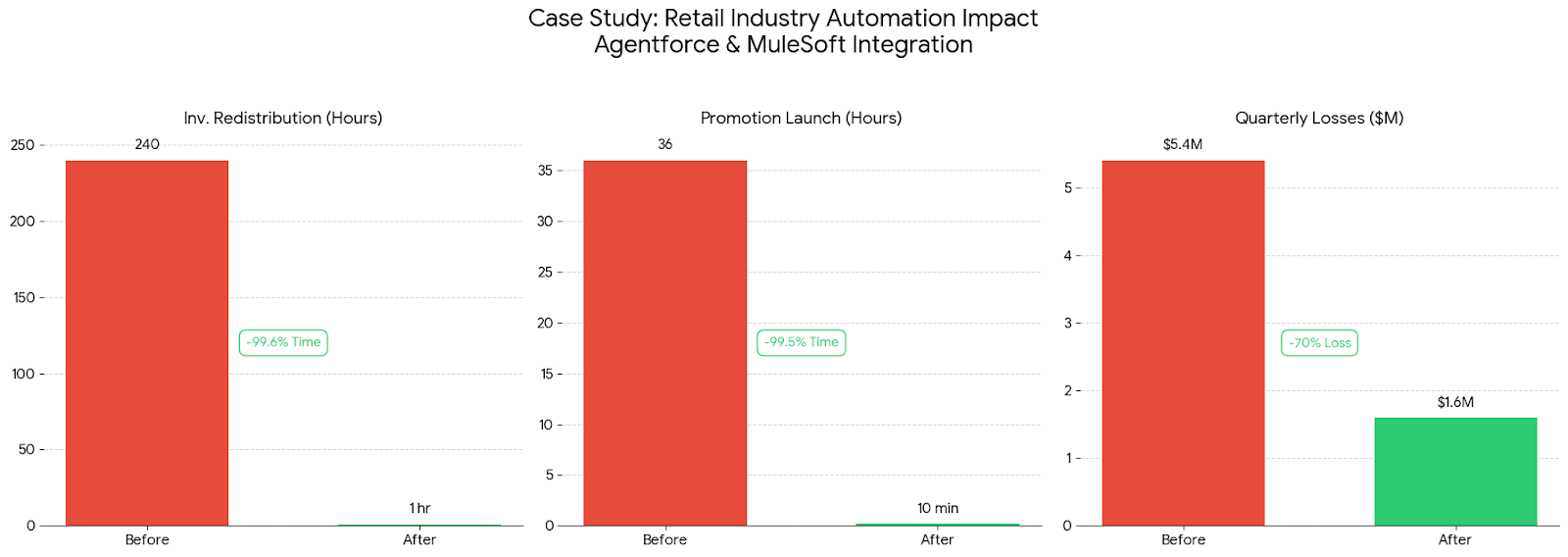
Agentforce case studies show large efficiency gains. Support workloads handled by hybrid agent-human teams at a fraction of previous cost, faster resolution, higher satisfaction. Agents handle the straightforward 80 percent, escalate the complex 20 percent.
B2B procurement
In B2B ecommerce, agents handle quote-to-order flows, contract pricing, approvals, and reorders while respecting permissions, net terms, and audit trails. Complex procurement becomes as frictionless as consumer one-click, but within enterprise controls.
That’s the sell side. The buy side is where this gets uncomfortable.
Consumer Agents Coming for Your Traffic
Personal AI assistants are acting as shopping concierges. AI shopping agents in ChatGPT or other tools research, rank, and shortlist options across multiple retailers, check delivery and returns, then let users confirm or delegate full checkout.
As trust grows, these agents will automate repetitive purchases: groceries, pet food, household supplies, subscription renewals. Users set preferences and budget once, agents handle execution.
The data backs this up.
McKinsey, Adobe, and multiple research polls show a majority of consumers either already use AI for shopping or expect to within 12 months. Not early adopters. Mainstream intent.
But here’s the catch: trust is uneven. Consumers trust retailer-branded or bank-branded agents more than generic assistants. Many aren’t comfortable with fully autonomous checkout for everything yet. “Yet” is doing heavy lifting in that sentence.
SEO 2.0 aka Human + Agent Optimization
When agents do the searching and filtering, the battleground shifts. You’re no longer ranking in human-facing search. You’re being preferred in agent decision logic.
Your product data must be clean, structured, and semantically rich so agents can parse features, constraints, and trade-offs. Sloppy data that humans can interpret through context? Agents skip it.
You need agent-ready APIs and feeds exposing real-time price, stock, delivery, and policy details. If ChatGPT or Perplexity can’t pull your inventory status programmatically, you’re invisible to their recommendations.
Think of it as a new discipline.
You must make your offers machine-readable and competitively attractive so agents select you in multi-variable optimizations: price, speed, reliability, reviews, sustainability, whatever constraints users set.
Traditional SEO optimized for one variable at a time and assumed humans would click through to decide. Agent optimization means competing on the full bundle because the agent is making the decision, not presenting options.
Which raises an uncomfortable question.
Who Owns the Customer
If consumers primarily interact with a general assistant like ChatGPT, Google, or anything else, that assistant becomes the primary interface and gatekeeper. Search engine dependency on steroids, but more concentrated because one assistant handles everything.
Launch your own branded agents on your site and app to maintain a direct relationship, while still participating in third-party agent ecosystems for reach. You can’t afford only one channel.
Even if you solve the ownership problem, there’s the retention problem and which leads us to the next one.
Loyalty
Agents optimize for utility metrics: price, ratings, availability, fit with constraints. They don’t care about emotional attachment.
Loyalty shifts from “I love this brand” to “my agent consistently finds the best combination for me.” Brands move toward subscriptions, replenishment programs, and data-driven personalization that lock in agent-friendly recurring behavior.
Your existing loyalty infrastructure probably won’t cut it.
Your loyalty programs must speak to agents as much as humans. Clear value rules, predictable rewards, APIs that let agents evaluate benefits and redemption. If your points program requires reading fine print, agents route around it.
And then there’s the part everyone’s quietly worried about but not addressing.
The Risk Everyone’s Ignoring
Agentic commerce introduces new fraud and security problems that traditional systems weren’t built for.
Fraud at machine speed: Malicious agents exploit promo codes, test edge cases in returns policies, or perform account takeovers faster than human attackers. You need agent-aware fraud and bot-defense systems, not just CAPTCHA.
Accountability gaps: If an agent makes a poor or unauthorized decision—books wrong travel dates, makes a risky purchase—who’s responsible? User, platform, or merchant? Regulation hasn’t caught up. Everyone’s building fast, the legal frameworks are lagging.
The situation is already complex, and privacy concerns complicate it further.
Data privacy and consent: Agents need deep access to behavioral and financial data. One data breach involving an agent’s purchasing history and you’ve got a nightmare scenario.
Consumer confidence in AI-mediated payments is still forming. Industry groups say adoption hinges on robust identity, explainability, and dispute-resolution mechanisms. Translation: nobody’s figured out the trust layer yet.
So where does this actually go?
2025-2030
Agent-to-site is here. Agents acting as super users that browse sites and APIs on behalf of humans are live in travel, retail, and subscriptions.
The next phase is already taking shape. The Agent-to-agent (A2A).
Where consumer agents negotiating directly with merchant agents while humans mostly setting goals and constraints, grows rapidly later this decade. That means:
Commerce becomes more invisible.
Most recurring and low-consideration purchases become hands-off.
Human attention gets reserved for configuration, edge cases, and high-stakes choices.
So, What to Do Now
Invest in agent-ready infrastructure: APIs, structured data, payments, fraud controls. Waiting until agents dominate a category means you’re already sidelined.
Treat agents as a new customer class. Design products, data, pricing, product descriptions with vivid details so that both humans and their AI representatives find attractive and easy to work with.
Start with the basics.
If your product data is a mess, your APIs are slow, or your inventory feed updates once a day, fix that before you worry about the next ChatGPT feature launch. Agents won’t wait.
What are you seeing in your space? Have you started building your SEO strategy for agent-driven commerce? Hit reply and let me know.
Signing out, Pankaj